Understanding the Real Differences Between Today's Most Discussed AI Platforms
Three names keep coming up whenever business leaders start talking about AI: ChatGPT, Microsoft Copilot, and Hatz AI. Each one is being used by real organizations right now. Each one promises to boost productivity and simplify work.
But here's what most articles won't tell you: the right AI tool for your business depends almost entirely on how it handles data, governance, and integration — not just how impressive the demo looks.
This post breaks down what each platform actually does, where each one fits best, and what business leaders should ask before adopting any of them.
ChatGPT: The Pioneer That Started the Conversation
ChatGPT popularized generative AI for the mainstream — and for good reason. It's powerful, flexible, and impressively capable across writing, analysis, research, and coding.
For business use, the real question is: where does it fall short?
Strengths:
- Excellent for general-purpose content and ideation
- Fast, intuitive interface — low learning curve
- Wide range of plugins and API integrations available
Business Limitations:
- Limited built-in governance and data controls
- Employees may inadvertently share sensitive data
- No enterprise audit trail by default
- Requires a disciplined usage policy to be safe at scale
ChatGPT is a great starting point — but in regulated industries or environments with sensitive data, it needs guardrails that most organizations haven't built yet.
Microsoft Copilot: Deep Integration, With Real Tradeoffs
If your business runs on Microsoft 365, Copilot is the AI tool you've probably already heard about — or been pushed toward. It's embedded directly into Word, Excel, Teams, Outlook, and PowerPoint, which gives it a significant advantage in day-to-day usability.
Strengths:
- Native integration with Microsoft 365 apps
- Summarizes meetings, drafts emails, analyzes spreadsheets in context
- Governed by your existing Microsoft tenant permissions
Business Limitations:
- Only as good as your existing M365 data structure and hygiene
- Significant additional licensing cost on top of existing M365 plans
- Adoption rates are often lower than expected without a proper rollout plan
- Locked into Microsoft's ecosystem — limited flexibility
Copilot is genuinely useful — but buying the license is only step one. Without a structured adoption plan, many organizations pay for a tool their teams barely use.
Hatz AI: Built for Business Governance From Day One
Hatz AI was designed with a different priority in mind: not just AI capability, but AI that businesses can actually trust, control, and scale responsibly.
Strengths:
- Multi-model access — not locked to one AI engine (58 current models)
- Enterprise-grade data isolation and privacy controls
- Built-in policy enforcement and usage governance
- Full audit trails and reporting for compliance-driven organizations
- Designed for regulated industries (healthcare, finance, legal, government)
Business Considerations:
- Less well-known than ChatGPT or Copilot — requires internal champion
- Best value realized with a clear AI use case and adoption roadmap
For organizations where data privacy, compliance, and accountability matter, Hatz AI closes the governance gap that other platforms leave open.
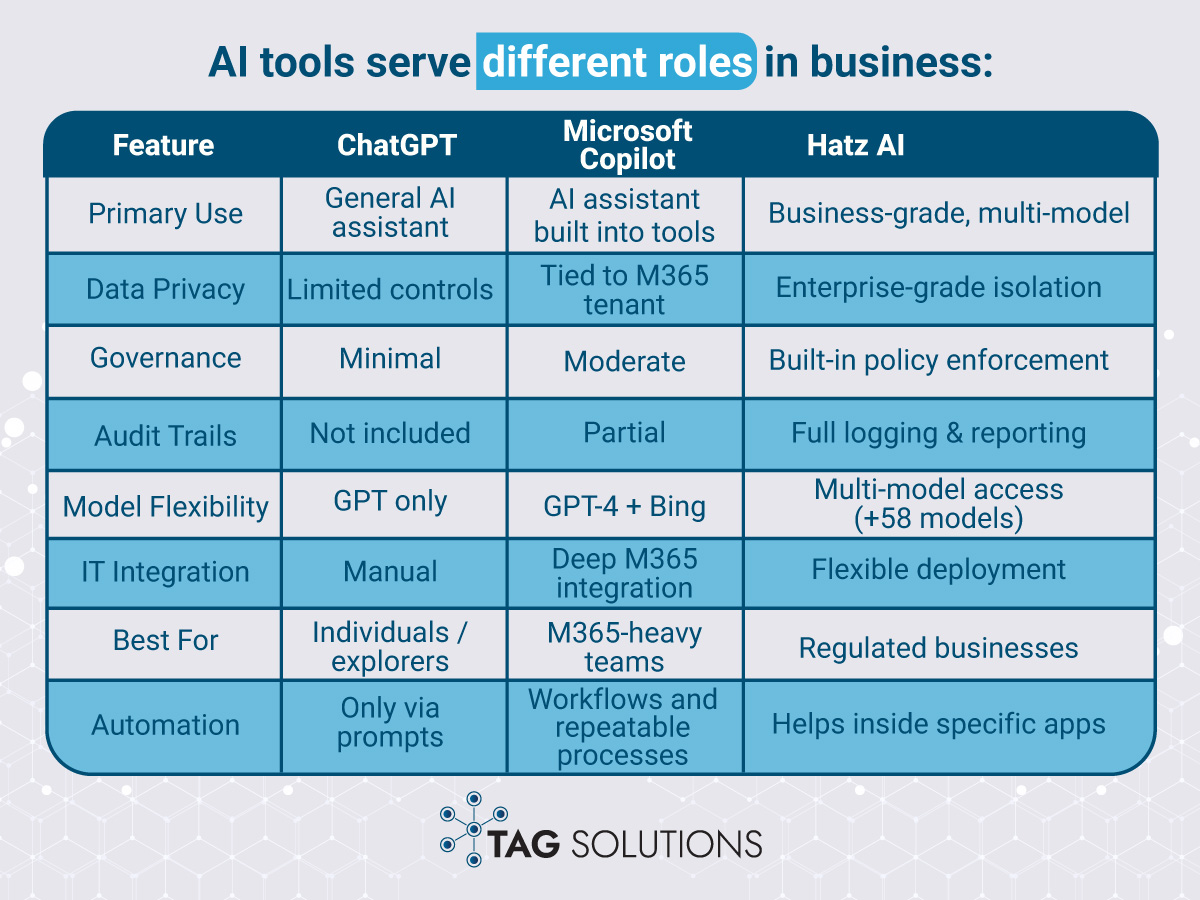
Side-by-Side: What Matters for Business
Here's how the three platforms compare across the criteria that matter most to business leaders — not just tech enthusiasts:
Choosing the Right Tool Is Only Half the Battle
Here's what most AI comparison articles skip entirely: choosing the right platform matters far less than how you implement it.
Without a clear strategy, even the best AI tool can create new problems — data leaks, compliance gaps, frustrated teams, and wasted spend. That is exactly where AI integration changes the conversation, shifting the focus from picking a tool to connecting AI securely and strategically to the systems your business already relies on. The organizations that get real value from AI are the ones that invest in adoption planning, usage policies, and ongoing governance — not just the technology itself.
- Do you have a clear use case and measurable goal for AI adoption?
- Do employees know what data they can and cannot share with AI tools?
- Is there a governance policy in place before deployment begins?
- Who owns AI accountability in your organization?
If these questions don't have clear answers yet, the conversation needs to start before you select a platform.
How TAG Solutions Helps You Navigate This Decision
TAG Solutions isn't here to sell you a specific AI tool. Our job is to help you make the right decision for your business — and then implement it so it actually works.
Through our vCIO-led AI Strategy Sessions, we help business leaders:
- Assess your current AI readiness and data governance posture
- Evaluate which platform aligns with your industry, compliance needs, and budget
- Build an adoption roadmap that drives real team utilization — not shelf-ware
- Establish an AI usage policy before problems surface
We've seen what happens when AI gets rolled out without a plan. We also know what good implementation looks like — and the difference in business outcomes is significant.
The Bottom Line
ChatGPT, Microsoft Copilot, and Hatz AI each have a place in the modern business technology stack. The question isn't which one is best — it's which one is right for your situation, and whether your organization is ready to use it responsibly.
Use this as a starting framework:
- ChatGPT → Best for teams exploring AI with low-sensitivity workflows
- Microsoft Copilot → Best for M365-heavy organizations with proper adoption support
- Hatz AI → Best for regulated industries needing governance, privacy, and multi-model control
Not sure where your business fits? That's exactly what a strategy session is for.

Work with Tag Solutions to identify the right AI platform for your business and build an implementation roadmap that actually gets used.