Before you buy another AI tool, read this
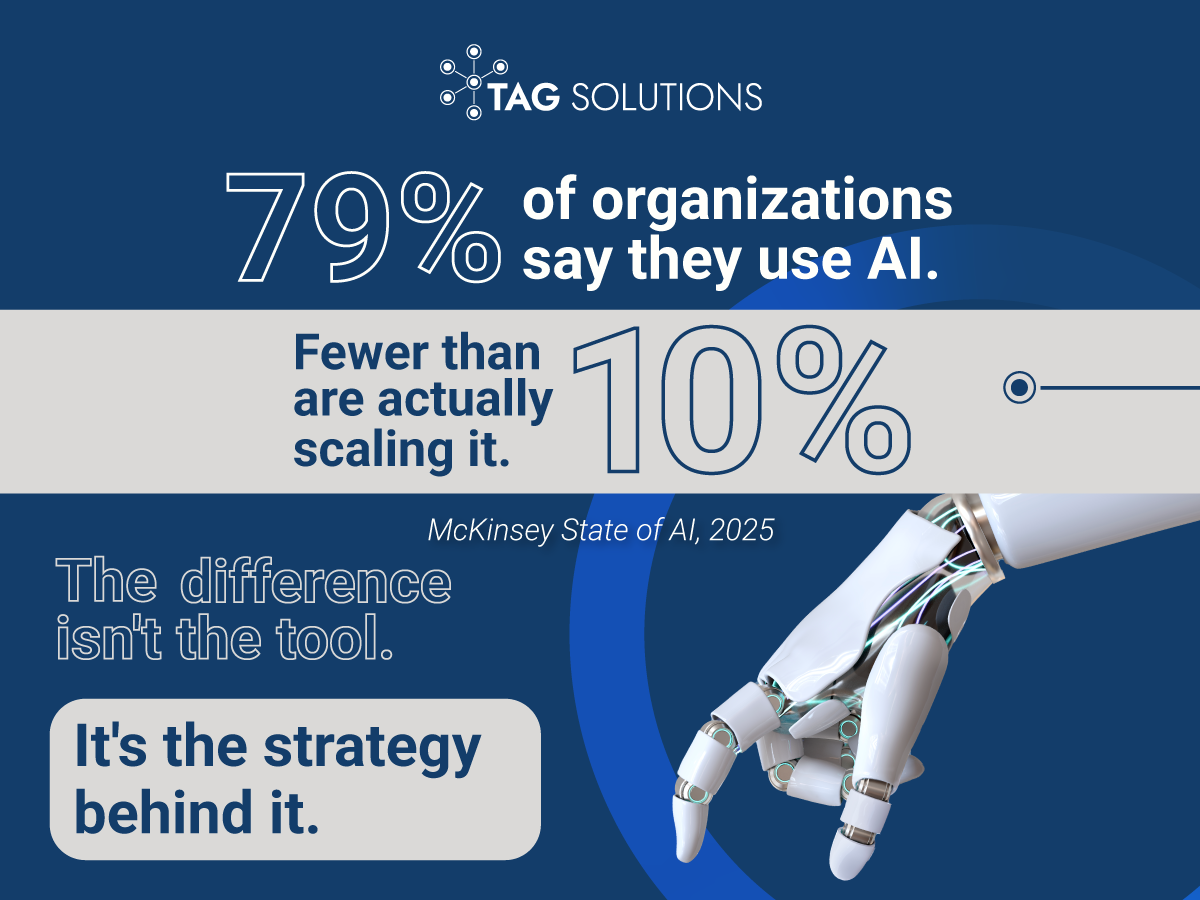
Almost evry organization today have done something with AI. There are some people using ChatGPT. On the other hand, the company is paying for Microsoft Copilot. Moreover, a few tools got tested in a meeting. But if you ask leadership if AI is actually improving their bottom line, the answer is often less clear.
The reason is really simple: there is a significant difference between using an AI tool and integrating AI into how your business actually operates. One produces quick answers, but the other produces measurable ROI.
The Tool Trap: Why Using AI Is Not the Same as Integrating It
What AI Tools Actually Are
AI tools like ChatGPT, Copilot, Gemini, and other latforms are designed to be accessible and some of them are even free. You open a browser, type a question, and get a response. That accessibility is nice and feels right.
But these tools are one-size-fits-all. They just respond to prompts. They do not really know your business. They do not connect to your CRM, your ticketing system, your ERP, or your data warehouse. Some tools now include memory features, but they only remember what you have told them in past conversations. They still do not know your systems, your data, or how your business actually runs.
Where AI Tools Fall Short
Here is where organizations tend to hit a wall:
- Each employee uses the tool differently, producing inconsistent outputs.
- Data entered into consumer AI tools can create privacy and compliance risks.
- Memory is limited to what you share in conversation. There is no process continuity and no real connection to your business logic.
- Results depend entirely on how well each individual can write a prompt.
- Free and consumer-grade AI tools were not built to enterprise security standards. Data you enter may be used for model training, stored in ways you cannot control, or exposed to risks your business cannot afford.
None of this makes AI tools bad. It makes them the starting point, not the destination. Choosing the right AI tool for your business still matters, but a bigger question is how that tool fits into your workflows, governance, and long-term strategy.
What AI Integration Actually Means
APIs: The Bridge Between AI and Your Business Systems
AI integration is the process of connecting AI capabilities directly into your existing workflows and systems through Application Programming Interfaces, commonly called APIs.
Think of an API as a secure, structured handshake between two software systems. When AI is integrated via API, it can read from and write to your actual business systems. It can pull customer data from your CRM to draft a personalized quote.
That is a fundamentally different capability than copying a question into a chatbot and reading the response.
How AI Integration Looks Like in Practice
Integrated AI is not a single product. It is a layer of intelligence embedded in how work gets done. Some real examples:
- A healthcare organization uses an AI model connected to their patient scheduling system to predict no-shows and fill gaps, reducing lost appointment revenue
- A financial services firm integrates AI into their document review process, flagging mistakes before contracts go to legal review
- A manufacturing company connects AI to a sensor data from the production floor, receiving alerts about equipment performance before a failure happens
- An insurance company uses AI to handle incoming claims by urgency and document type, routing them to the right adjuster automatically
In every case, the value is not the AI model itself. It is the connection between AI and the systems where your business actually runs.
The Business Case: Where AI Integration Creates Real ROI
Operational Efficiency
Integrated AI eliminates repetitive, manual steps from workflows your team runs every day. When those steps involve pulling data, formatting reports, routing requests, or generating standard communications, AI can handle them faster and with less errors.
The result is not just time savings. It is your people spending more time on the work that requires judgment, relationships, and expertise. That is where human value concentrates.
Decision Intelligence
AI connected to your business data does not just automate tasks. It gets patterns that humans would miss or catch too late.
For instance: Which customers are most likely to walk away? Which invoices are trending toward payment delays? Which support issues are increasing in volume this week? When AI has access to your systems, it can answer these questions continuously, not just when someone thinks to ask.
Customer Experience
Businesses that integrate AI into their customer processes can respond faster, personalize more effectively, and resolve issues before they escalate. That is a competitive advantage if you know how to doit right.
The Risks of Getting Integration Wrong
AI integration done without proper planning creates serious risks. These are worth understanding before you begin.
Data Security and Access Control
When AI is connected to your business systems via API, it gains access to data. If that access is not carefully scoped and controlled, sensitive information including customer records, financial data, and employee details can be exposed in ways that are difficult to detect and even harder to reverse.
Every AI integration requires a clear answer to: what data can this system see, who authorized that access, and how is it logged?
Governance and Oversight
Integrated AI can act, not just respond. If governance is not built in from the start, automated actions can produce a lot of errors. A misconfigured rule in a workflow does not make one mistake. It makes the same mistake repeatedly, until someone notices.
This is why AI governance, the policies and controls that define how AI operates inside your organization, is not an optional decision. It is a must.
Three AI Platforms Built for Business Integration
Understanding AI integration in principle is useful. Knowing which platforms actually make it work is more useful. These three are practical starting points for organizations ready to move beyond standalone tools toward connected workflows.
- Zapier + AI Actions
Connect more than 7,000 apps and trigger AI-powered actions. Summarizing emails and drafting follow-ups. Without writing a single line of code. If your team just wants to test integration, you can start with this tool. - Microsoft Power Automate + AI Builder
Already on Microsoft 365?. This tool help yu with document processing and data analysis. Built into your existing tenant, respecting your current data governance and permissions. No will not need a new vendor. - Hatz AI: AI-Powered Workflows Built for Business
Hatz AI is an AI platform for business productivity and workflow integration. It connects into project management tools, CRMs, communication platforms, and internal knowledge bases to deliver responses and automation. For organizations that want AI built for business, and not adapted from a consumer product, Hatz AI is worth a close look.
How TAG Solutions Can Help You to Integrate AI
Most organizations know they should be doing more with AI. What they lack is almost the same, safe path from where they are today to where they want to be.
That is exactly what TAG Solutions helps clients build. TAG does not sell AI tools. TAG helps you build an AI strategy aligned with your business goals, your risk tolerance, and your operational reality.
If your organization is using AI but not with a clear objective, the gap is likely in how AI can gelp you to achieve your business goals, not in which tool you chose.
A vCIO Strategy Session gives you a structured conversation about where AI integration can deliver real ROI for your company, and what it takes to get there safely.

Just a strategic conversation with people who understand both technology and business.