The tools are already in use. The data is already leaving. Most leaders still cannot answer one question: which AI tools?
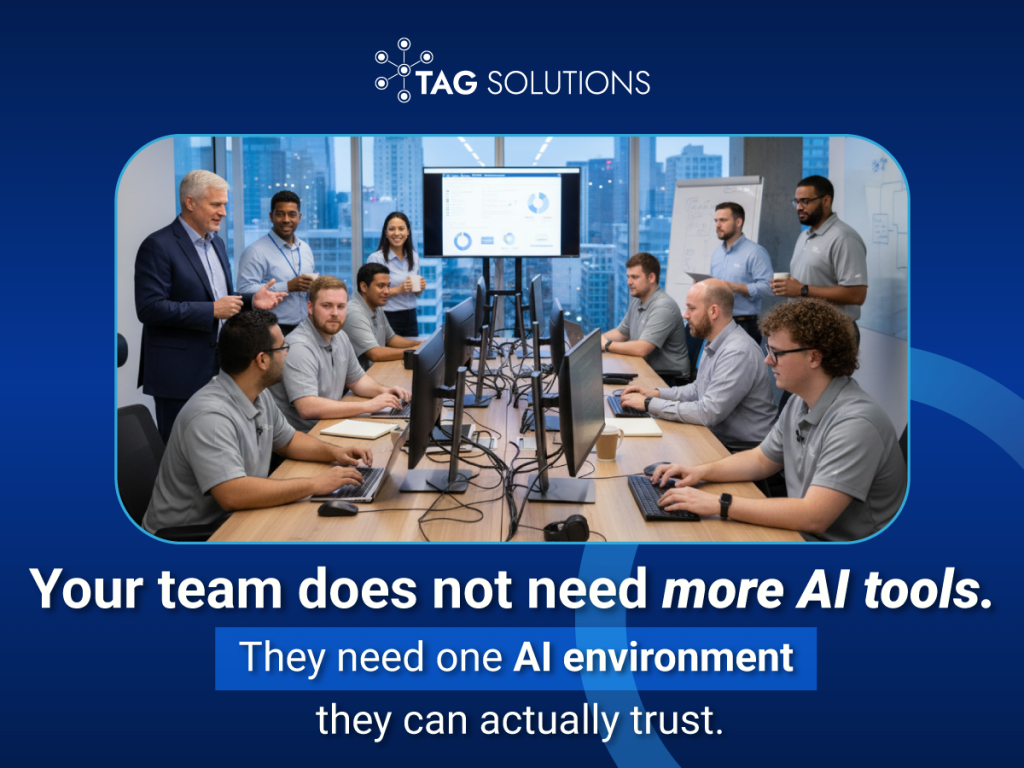
Your team is already using AI. The question is which tools, and whether your business can control them.
This is not a future concern. It is a current operating reality for most organizations. Employees are using ChatGPT to draft communications. They are using Gemini to summarize documents. They are downloading browser extensions that process company data in ways nobody has reviewed. None of it is logged. None of it is covered by policy. None of it required approval.
And most leaders have no idea how much of this is happening inside their own organizations.
This is not a technology problem. It is a governance gap. And it carries real business risk that does not look like a breach, does not appear on a security report, and does not surface until someone asks a question you cannot answer.
What Shadow AI Actually Looks Like
Shadow AI refers to the use of artificial intelligence tools across an organization that were never formally evaluated, approved, or governed by leadership or IT.
It looks like this: An account manager uses a free version of ChatGPT to summarize a client's financial records before a meeting. The content is processed by an external AI model. The data leaves your organization. Nobody is notified. Nothing is technically breached.
A marketing coordinator uses an AI writing tool to draft a proposal. The tool stores conversation history and uses it to improve its own model. The intellectual property in that proposal is now part of a third-party dataset.
An HR manager uses a browser extension to screen resumes. The tool processes personal employee data in a way that likely conflicts with your data handling obligations.
These scenarios are not hypothetical. They are what happens when employees find tools that help them work faster and no framework exists to guide how those tools are used.
The problem is not the employees. The problem is the absence of policy, visibility, and a governed alternative.
Why This Is a Business Risk, Not a Technology Problem
When AI tools operate outside of governance, the exposure is business exposure, not just technical exposure.
- Data security. When employees submit company information to free AI tools, that data may be used to train external models, stored on third-party servers, or made accessible in ways that conflict with your client agreements or regulatory obligations. HIPAA-covered organizations face particular risk here. So do any organizations handling confidential client data, financial records, or legal documents.
- Many industries now require organizations to demonstrate control over how data is accessed and processed. An unmanaged AI environment creates compliance gaps that can surface during audits, vendor reviews, or regulatory inquiries.
- If a client's information is handled improperly by an AI tool your employee was using without approval, the question of organizational responsibility is not straightforward. "We did not know they were using it" is not a policy.
- Decision quality. When AI tools operate without governance, outputs cannot be trusted consistently. Different employees are using different models, with different context, generating different results. The lack of standardization affects the quality of work, the consistency of communications, and the reliability of AI-assisted decisions across your organization.
The governing principle here applies to any significant business investment. AI decisions should follow the same discipline. A company would not allow employees to sign vendor contracts without review. The same logic applies to the AI tools those employees use every day.
What a Governed AI Environment Looks Like
A governed AI environment is not about restricting access to artificial intelligence. It is about making sure the access your organization provides is secure, auditable, and aligned with your policy.
In practice, this means four things.
- One platform. Rather than allowing employees to use any AI tool they find convenient, a governed environment gives your entire team access to every leading model through a single approved platform. ChatGPT, Claude, Gemini, and others, all accessible in one place, under one policy.
- Data that stays yours. In a governed platform, your data is not used to train external AI models. Sessions are processed in a way that keeps your organizational data under your control. This directly addresses the exposure created by free consumer AI tools.
- Usage that is logged and auditable. Every interaction is recorded in a way that leadership and IT can review. This gives organizations the visibility they need to understand how AI is being used, identify any risks, and demonstrate compliance when required.
- One policy for every employee. Rather than managing AI governance tool by tool, a governed environment allows you to set one acceptable use policy that applies across the entire organization, regardless of which AI model an employee is working with.
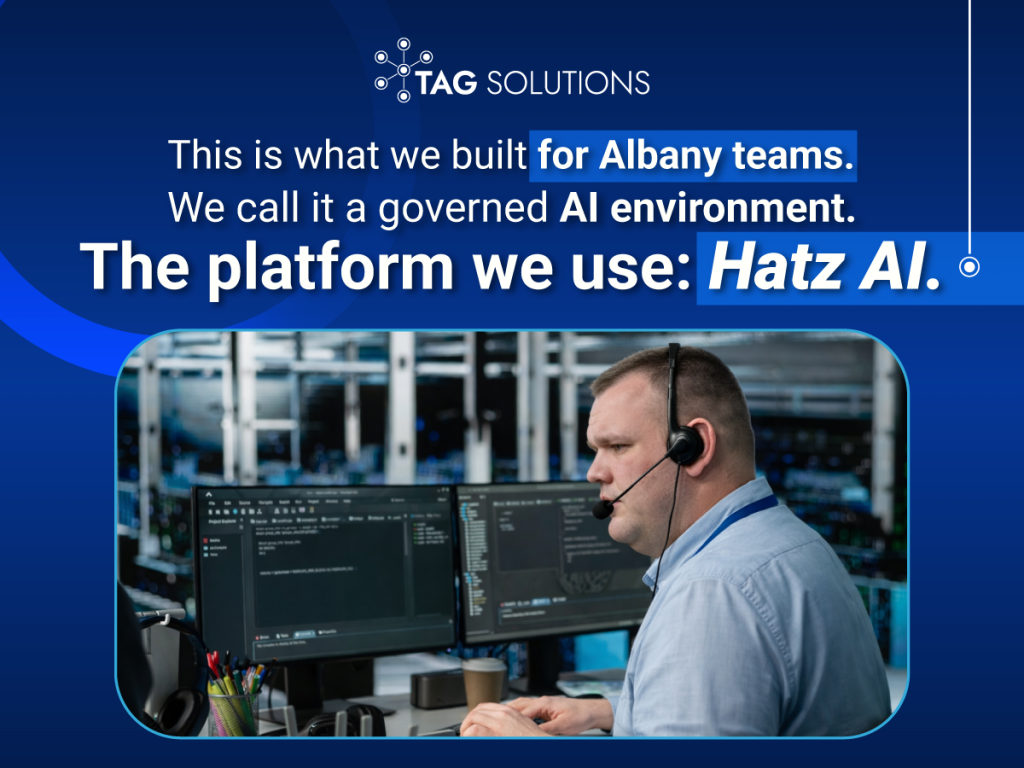
When we evaluated this model for Albany organizations, the platform that addressed all of these requirements was Hatz AI. It brings every leading AI model into one governed environment, keeps data protected, and gives leadership the visibility they need without restricting the productivity gains their teams are realizing.
Where Albany Organizations Should Start
Building an AI governance framework does not have to be complicated. It starts with a few clear decisions.
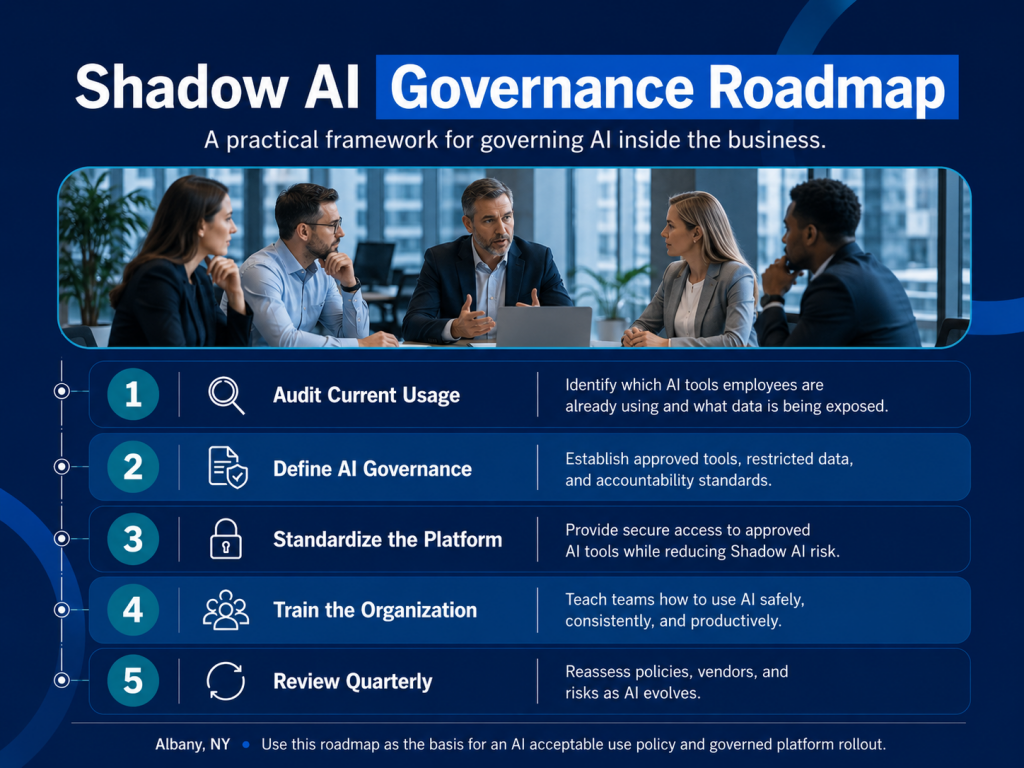
- Audit what is already in use. Before building policy, understand the current state. Which AI tools are your employees using? Which departments are most active? What kinds of data are being processed through those tools? This audit is often more revealing than leaders expect.
- Build an acceptable use policy. An AI acceptable use policy does not need to be long. It needs to define which tools are approved, what types of data can be processed through AI systems, and what oversight exists. This document becomes the governance foundation.
- Choose a single governed platform. Moving from many unmanaged tools to one governed platform is the most impactful step an organization can take. It provides your team with the AI access they need while eliminating the governance gaps created by consumer tools.
- Train your team. Governance without training creates confusion. Your employees need to understand not just what they are allowed to use, but why the framework exists and how it protects both the organization and them.
- Review and update regularly. AI tools and capabilities are evolving quickly. A governance framework that is accurate today may need to be updated in six months. Building a regular review process into your IT strategy ensures your organization stays ahead of changes rather than responding to them after the fact.
This is exactly the kind of strategic IT work that a vCIO helps organizations navigate. Not just choosing a platform, but building the policy, managing the rollout, and creating the governance structure that makes adoption sustainable long term.
The Window for Getting Ahead of This Is Closing
Most Albany organizations are not behind on AI adoption. They are behind on AI governance. The tools are already in use. The gap is in who owns the policy, who has visibility, and what framework exists to guide the decisions being made every day.
Organizations that close this gap now will have a measurable operational and compliance advantage over those that address it after an incident forces the conversation.
On July 2, we are bringing Albany business leaders together to work through exactly these questions. Not in theory. In practice. We will break down a real Albany business workflow and show what a governed AI environment looks like when applied to an actual operational challenge.
________________________________________________________________________
If you want to see what a governed AI environment looks like for your organization and explore 60 days of complimentary Hatz AI access, this event is where to start.
________________________________________________________________________
Quick Q&A: Shadow AI Governance
Is shadow AI always “bad”?
No. The productivity gains are real. The risk is unmanaged use: unapproved tools, unclear data rules, and no audit trail.
What data should never go into public AI tools?
Client data, employee records, financials, legal documents, credentials, and anything covered by HIPAA or contractual confidentiality.
Do we need to ban ChatGPT?
Not if you provide a governed alternative. Most organizations get better results by standardizing on approved tools and logging usage.
Who should own AI governance?
It should be shared: the CEO sets risk tolerance, IT/vCIO runs the program, and security/compliance defines controls and review cadence.
What is the first step?
Run a quick audit: which tools are in use, which teams are using them, and what data is being processed.