What digital provenance is, why it matters, and what business leaders need to know before it becomes a liability
Most organizations create a significant amount of digital content. Reports. Communications. Marketing materials. Contracts. Proposals.
But ask whether any of it can be verified as authentic, and the answer is usually silence.
That silence is becoming a business risk.
What Is Digital Provenance?
Digital provenance is the ability to verify where a piece of content came from, who created it, when it was created, and whether it has been altered.
Think of it as a chain of custody for your digital assets.
It applies to documents, images, videos, audio files, and increasingly, AI-generated content. As AI tools become a standard part of how businesses operate, the question of provenance is no longer a technical detail. It is a governance question.
Why It Matters Now
For most of business history, provenance was not something you had to think about.
A document came from your team. A photo was taken by your photographer. A report was written by your analyst. The source was obvious.
AI has changed that assumption. Content can now be generated in seconds, by anyone, using tools that leave no visible trace. A report, an image, a contract, a communication - none of it carries a built-in record of origin anymore.
That is not a technology problem. It is a trust problem.
The Business Risk Nobody Is Talking About
When content cannot be verified, three things start to happen.
Contracts get disputed. A document was altered. Nobody can prove when or by whom.
Decisions get made on bad information. A report was AI-generated, but nobody flagged it as such. Leadership acted on it anyway.
Liability grows. A vendor, a regulator, or a client asks for proof of authenticity. Your team has no answer.
None of these scenarios require a cyberattack. They just require a lack of process.
Where the Risk Shows Up
The industries that feel this first are the ones with the most to lose.
In healthcare, a patient record or clinical summary generated or edited by AI carries real liability if its origin cannot be documented. In financial services, a report that cannot be traced back to a verified source creates audit exposure. In legal and insurance, a single unverifiable document can unravel a case or a claim.
But this is not only a regulated industry problem.
Any organization that produces contracts, proposals, marketing content, or internal communications is exposed. The question is not whether your industry is regulated. The question is whether your business could survive a content authenticity challenge.
What Good Provenance Practice Looks Like
Organizations that are getting ahead of this are doing a few things consistently.
They are tracking content origin. Every document, image, or file has a record of who created it, what tool was used, and when.
They are flagging AI-generated content. Not to ban it, but to contextualize it. Leadership knows what was produced by a human, what was assisted by AI, and what level of review it received.
They are building governance policies before they need them. A content authenticity policy is not a response to a crisis. It is a business practice that prevents one.
None of this requires a massive technology overhaul. It requires intention, process, and the right partner to help operationalize it.
5 Steps to Protect Your Brand and Proprietary Information
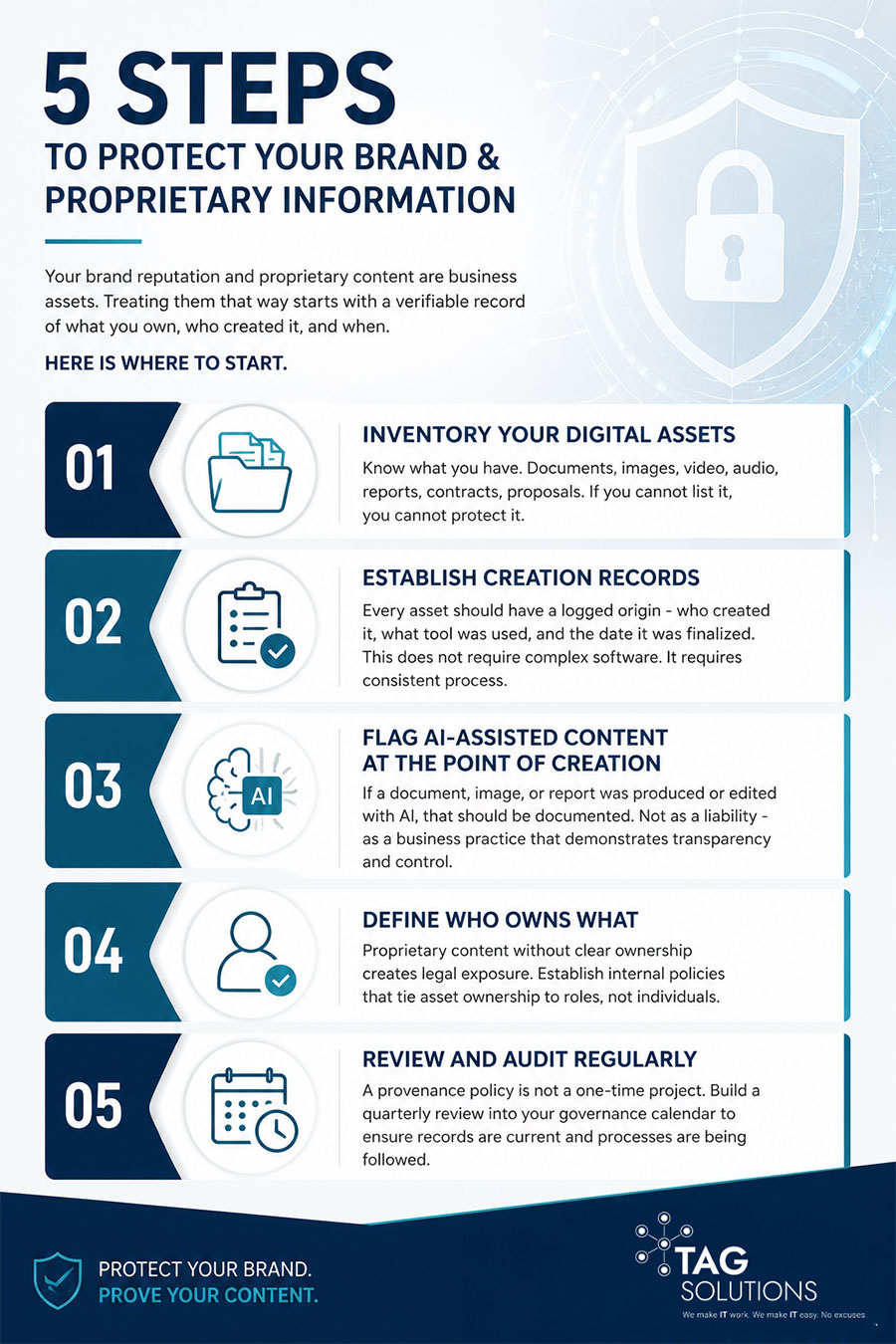
Your brand reputation and proprietary content are business assets. Treating them that way starts with a verifiable record of what you own, who created it, and when.
Here is where to start.
How TAG Solutions Helps
This is exactly the kind of challenge a vCIO is built for.
Most businesses do not need a new technology platform to address digital provenance. They need a governance framework, a clear policy, and someone who can translate that into practical steps their team will actually follow.
TAG Solutions works with organizations across Albany and the Capital Region to build AI governance programs that include content authenticity, policy documentation, and risk reduction - before a problem forces the conversation.
Our vCIOs bring the strategic perspective that internal IT teams rarely have time for. We do not just help you adopt AI tools. We help you adopt them in a way that protects your business, your clients, and your reputation.
That is not a technology conversation. That is a business conversation. And it is one worth having now.
Not sure where your AI governance gaps are?

And find out where your organization stands - before someone else finds out for you.