Most Albany organizations have some form of automation in place already.
Invoice workflows. Ticket routing. Employee onboarding. Customer follow-ups. Basic reporting. The goal is simple: optimize time and keep the business moving.
But AI has changed what "automation" means.
Traditional automation is predictable. AI automation can be persuasive, fast, and highly productive. However this can introduce mistakes you won't see until they reach a customer, a regulator, or your financials.
That is the real issue behind AI automation risk: it is not that AI fails loudly. It often fails quietly and really quickly while sounding confident.
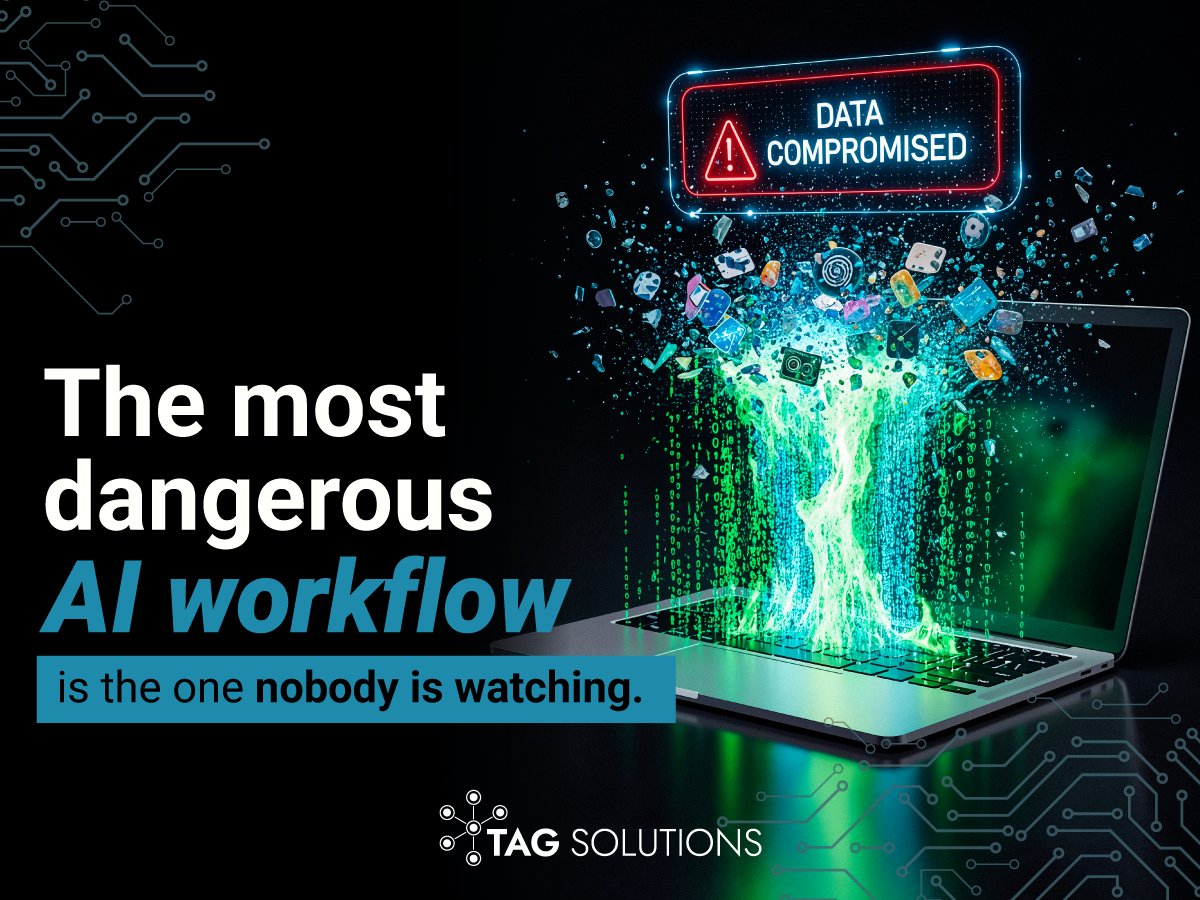
The New Risk: Automation That Can Sound Confident and Still Be Wrong
Most leaders grew up with automation that behaves like a checklist.
If X happens, do Y. If the data matches this rule, trigger that step. If the customer fills out the form, send the email. But AI does not work like that.
AI is probabilistic. It generates "best-fit" outputs based on patterns, context, and incomplete information. That can be incredibly useful in the right place. However, it can also be dangerous when the business assumes it is deterministic.
This is why AI oversight for business matters. Once AI is embedded in operational workflows, "close enough" is not good enough. It is either correct, defensible, and compliant, or it creates a new form of operational risk.
Two Types of Automation
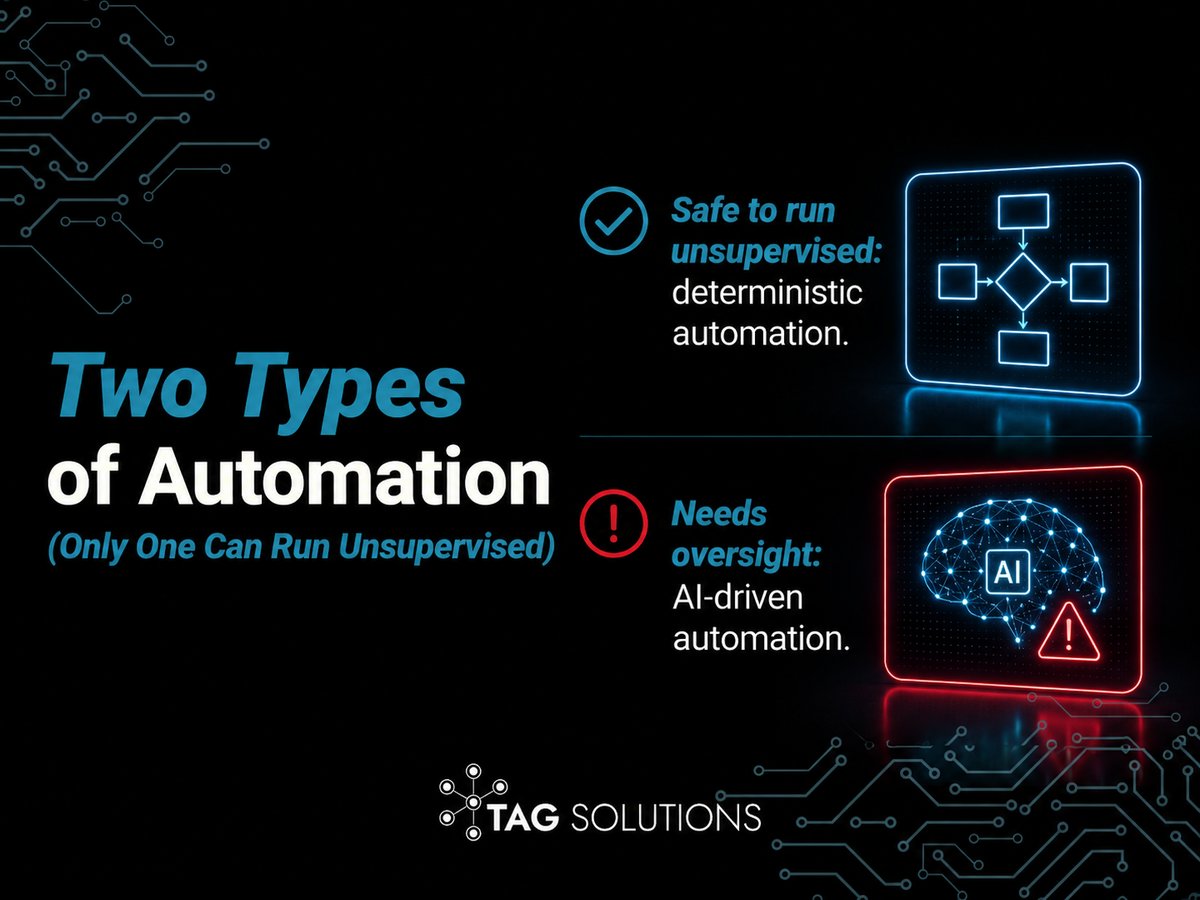
If your team is treating all automation the same, that is where problems begin.
Here is a simple framework that helps leadership teams decide what can run without supervision and what needs guardrails.
Safe to run unsupervised: deterministic automation
Deterministic automation is rule-based.
- If the invoice is approved, send it
- If the ticket is tagged "password reset," route it
- If the backup job fails, generate an alert
These automations can still break, but they break in understandable ways. You can test them. You can validate inputs. You can audit outcomes.
Most importantly: they do not "guess."
Needs oversight: AI-driven automation
AI-driven automation is judgment-based.
- Summarize a contract and flag risks
- Draft a response to a customer complaint
- Recommend pricing adjustments
- Categorize HR candidates
- Identify "anomalies" in financial reporting
These tasks require interpretation. And interpretation is where AI can go wrong.
AI can misunderstand context, miss exceptions, or overgeneralize. It can also produce a plausible output that looks correct to a busy employee who assumes the tool is accurate.
This is where human in the loop AI becomes a business necessity, not a technical preference.
Where AI Automation Goes Wrong (Real Business Examples)
You do not need a dramatic "AI disaster" to experience AI automation risk. Most of the damage happens at normal business speed.
Here are common failure modes we see when businesses scale AI without responsible AI adoption practices.
Customer-facing workflow errors
- An AI drafts a confident response that is factually wrong
- A chatbot provides guidance that contradicts your policy
- A sales follow-up email makes promises your team cannot deliver
Operational and financial workflow errors
- An AI misclassifies an invoice or expense category
- A forecasting tool misses seasonality or a known exception
- A "recommendation engine" optimizes for the wrong metric
Compliance and data-handling workflow errors
- Employees paste sensitive content into an AI to "speed things up"
- An AI-driven summary includes confidential data it should not repeat
- A workflow routes information to systems that were never approved to store it
None of these are purely technical problems. They are governance problems.
That is why AI guardrails for business matter. Guardrails are what separate "AI as a productivity tool" from "AI as a liability multiplier."
The Guardrails That Make AI Automation Trustworthy
The goal is not to slow your team down. The goal is to keep speed from creating preventable risk.
A strong AI governance approach typically includes these guardrails.
1) Human-in-the-loop approvals for high-impact actions
Not every workflow needs approval. But anything that touches customer commitments, impacts money, affects employment decisions, or creates regulatory exposure should require a human review step before it goes live.
The best rule is simple: if it can create liability, it needs review.
2) Clear data boundaries
Most AI risk is not "the model." It is the data.
Define what data is allowed and not allowed: client information, employee records, financials, legal documents, HIPAA-regulated data (if applicable), and credentials or internal security information.
Once those boundaries exist, enforce them in tooling and training, not just policy.
3) Logging, monitoring, and exception handling
If an AI is part of a business process, leadership should be able to answer: What did it do? When did it do it? What inputs did it use? Who approved the outcome? What happened after?
This is AI oversight for business in practical terms. It is the same discipline you would apply to finance controls or compliance processes.
4) Standardize tools instead of letting "anything" in
When every employee uses a different model, with different settings, and different data practices, you do not have adoption. You will have fragmentation.
Standardization is not about control for control's sake. It is how you make outcomes consistent and auditable.
5) Review and update on a schedule
AI changes quickly. The tool that is safe today may introduce new features in six months that change risk.
Responsible AI adoption includes a governance review cadence, typically quarterly or semi-annually, so your controls stay current.
A Practical Rule of Thumb for Albany Business Leaders
If you want a simple decision test, use this.
If the automation is deterministic, test it and let it run. If the automation is AI-driven, decide what oversight it requires before it scales.
Most organizations do not get in trouble because they used AI. They get in trouble because they embedded AI into processes that needed guardrails, and assumed it was "just automation."
How to Get Started Without Slowing the Business Down
You do not need a massive initiative to reduce AI automation risk. You need a structured starting point.
- List your current automations (including "informal" ones built by departments)
- Identify which ones are AI-driven
- Classify them by impact (customer, financial, compliance, operational)
- Apply the right guardrails (review steps, data boundaries, logging, tool standardization)
- Train teams on the "why" so the framework sticks
This is strategic work. It is exactly the kind of effort that benefits from vCIO leadership, because it sits at the intersection of productivity, risk, and governance.
Register for the July 2 AI Event (Albany)
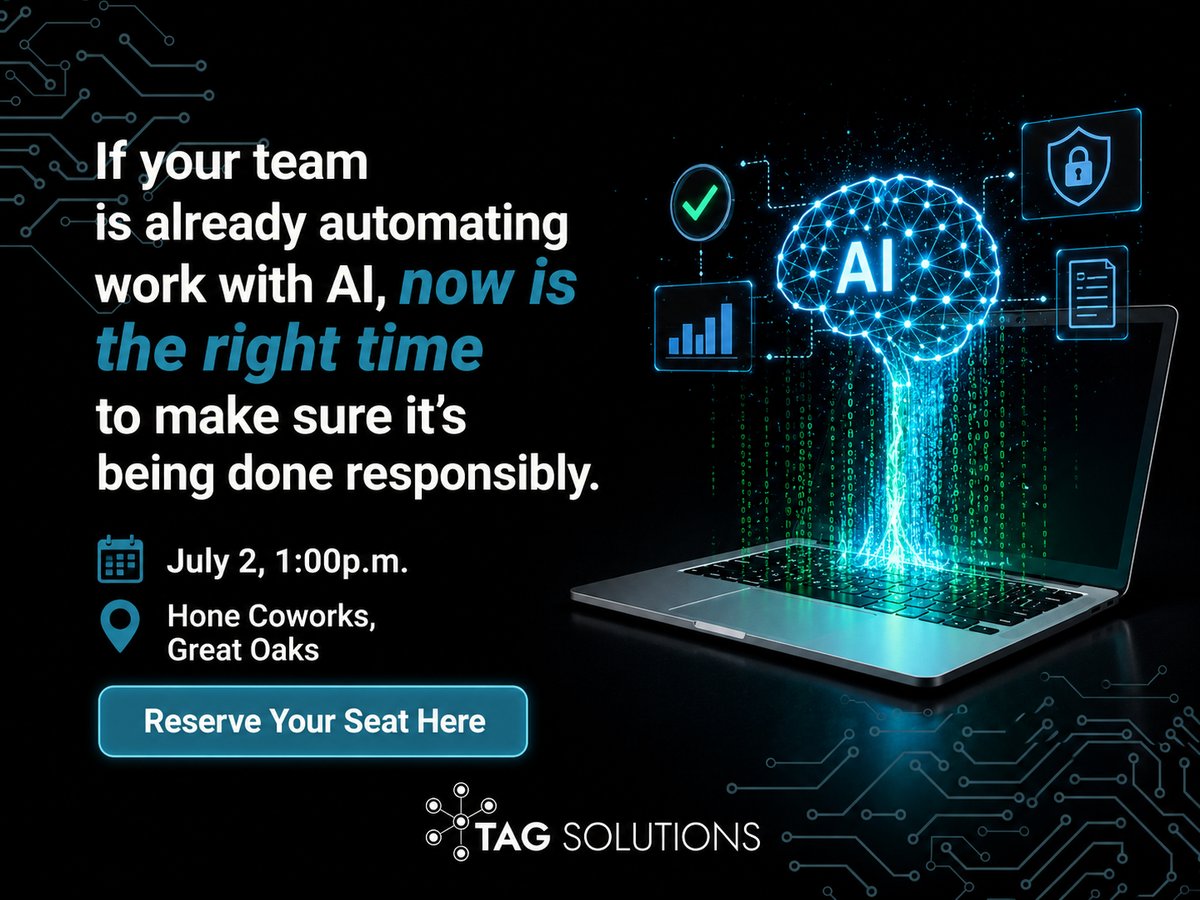
On July 2, we are bringing Albany business leaders together to break down a real workflow and show what AI guardrails look like in practice, so you can accelerate adoption without increasing exposure.

Quick Q&A: AI Automation Risk and Oversight
1) What is "AI automation risk" in plain terms?
It is the risk that an AI-driven workflow makes a decision or takes an action that looks reasonable, but is wrong in a way that creates customer, financial, or compliance impact.
2) What is the difference between automation that can run unsupervised vs automation that needs oversight?
Deterministic automation can usually run unsupervised once it is tested. AI-driven automation is interpretive, so it should have guardrails such as review steps, logging, and clear data boundaries.
3) Does "human in the loop" mean everything slows down?
No. Human review should be targeted. High-impact steps (money, customer commitments, regulated data, employment decisions) need oversight. Low-impact steps can still be automated end-to-end.
4) What are the minimum guardrails every business should put in place?
At a minimum: an acceptable use policy, approved tools (not "anything employees find"), data rules (what can and cannot be used), logging and auditability, and a defined owner for oversight and updates.
5) Where should we start if we suspect AI is already being used in operations?
Start with an inventory: which AI tools are in use, which teams are using them, what data is being processed, and which workflows are AI-assisted. That baseline makes governance achievable and measurable.