What school and district IT leaders need to build before AI tools become a compliance and data exposure problem.
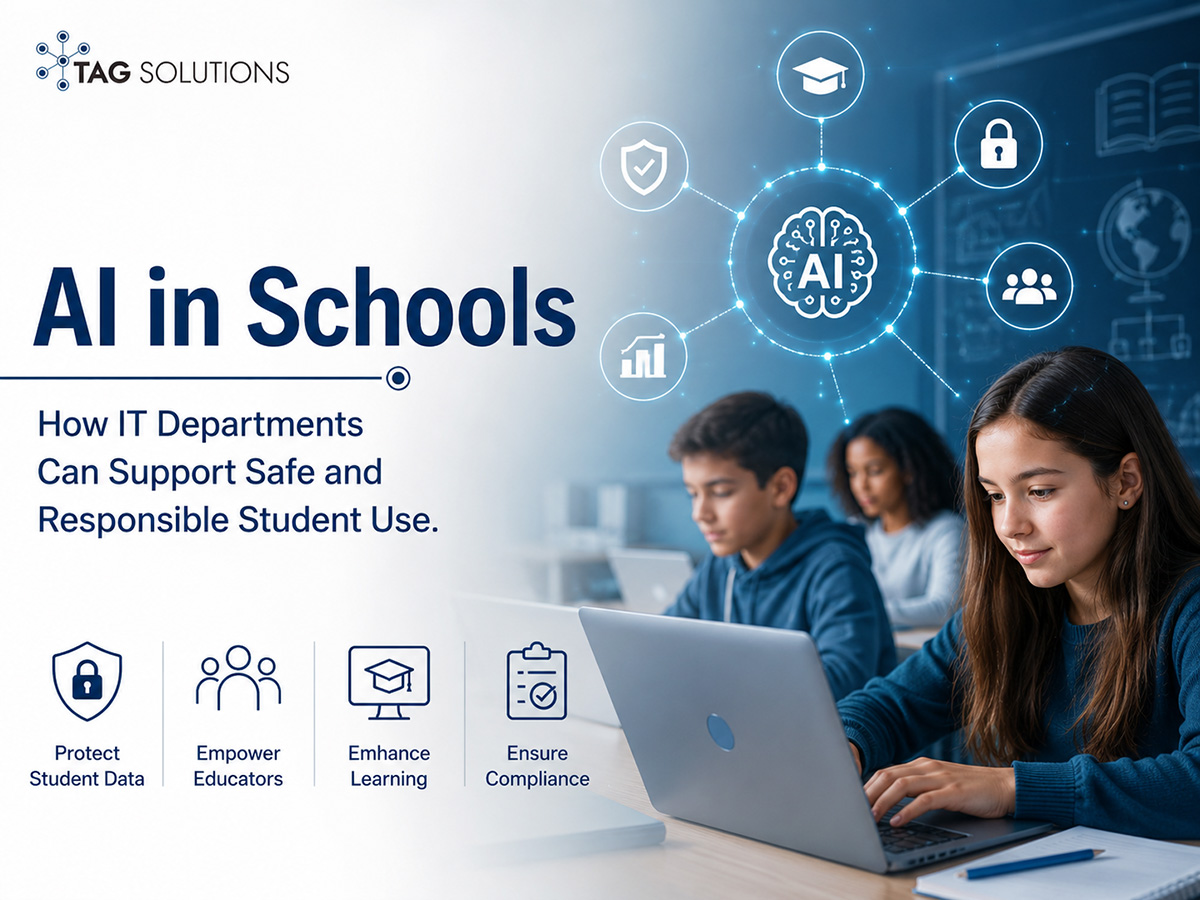
Spend enough time in K-12 IT and you recognize the pattern. A new consumer technology shows up. Students are using it before teachers have formed an opinion. Teachers start using it before IT has evaluated it. By the time anyone writes a policy, the tool is woven into daily workflows across three departments and fourteen classrooms. Then something goes wrong, or a compliance question surfaces, and the district finds itself in reactive mode on a problem that was visible months earlier.
That is exactly where most Albany school districts are right now with AI. Not behind. Not negligent. Just in the familiar position of trying to govern something that moved faster than the formal process.
The stakes with AI are higher than they were with social media or BYOD, and not because AI is inherently more dangerous. The stakes are higher because the compliance surface is broader. FERPA applies. New York Education Law 2-d applies. NYSED data privacy guidance applies. And none of those frameworks were written with generative AI in mind, which creates a gap that does not resolve itself without deliberate intervention.
What follows is not a policy template or a vendor comparison. It is a practical look at what responsible AI governance actually requires in a K-12 environment, why enterprise frameworks do not translate cleanly into school districts, and what the path forward looks like for Albany IT departments that want to get ahead of this rather than manage the fallout.
Why AI Governance in Schools Is Different from the Enterprise
There is a temptation to take an enterprise AI governance framework, strip out the corporate language, and adapt it for a school district. The instinct is understandable. The result is usually a policy that looks complete on paper but does not hold up in practice.
The core difference is the user population. Governing adult employees who signed an acceptable use policy as a condition of employment is a known problem with established tools. Governing minors carries a different legal weight entirely. FERPA restricts how student educational records can be accessed, processed, and shared with third parties. Education Law 2-d adds New York-specific obligations around vendor agreements and data use. When a student submits an AI-assisted assignment through a consumer platform, the data that flows through that transaction does not carry those protections forward automatically. The district's compliance posture depends on whether the tool was evaluated, approved, and covered by a vendor agreement before it reached a classroom.
The mixed workforce dimension compounds the challenge. Teachers, support staff, and students are each using AI tools differently, with different levels of risk awareness, and for purposes that range from drafting a rubric to completing an exam. A policy calibrated for administrative staff does not address student use. One written for students does not reflect the data handling risks in a teacher's workflow. You end up needing a layered framework, not a single document.
Speed of adoption is the third variable, and it is the one that catches most district IT departments off guard. Consumer AI tools do not wait for procurement cycles. A tool can go from discovery to widespread student use in a matter of weeks, well before any formal evaluation is complete. Building a governance framework that can accommodate that velocity, rather than one that assumes a stable, pre-approved toolset, is a meaningfully different design problem.
What Is Already Happening in Albany Classrooms
Before a governance framework can be designed with any precision, IT leadership needs an honest picture of current use. Not what the acceptable use policy permits. What is actually happening.
Students using consumer AI tools for academic work
ChatGPT, Gemini, and a range of AI tutoring and writing tools are embedded in how a significant portion of students approach their schoolwork. Some of this has been informally endorsed by teachers for specific assignments. Most of it was never evaluated by IT or reviewed by administration. Students are frequently working inside free-tier consumer accounts that store conversation history, process personally identifiable information, and operate entirely outside any district data governance framework. The fact that the device is a student's personal phone or laptop does not resolve the compliance question if a school account or school-related content is involved.
Teachers using AI to build and differentiate instructional content
The productivity case for AI in lesson planning is real, and most experienced educators have found at least one workflow where it saves meaningful time. Rubric development, assignment differentiation, parent communication drafts, quiz generation. The compliance concern is not the use itself. It is that most of this is happening through personal accounts on consumer platforms, with no vendor agreement in place and no district visibility into what data is being processed or retained.
Staff using AI to handle administrative data
This is where the exposure tends to be most acute and least visible. Administrative staff under deadline pressure routinely paste student information into public AI tools to get faster answers on scheduling, communications, or student support decisions. Names, grade levels, disciplinary notes, health accommodations. Data that is squarely within the scope of FERPA and Education Law 2-d. The tool being used almost certainly has no DPA, no 2-d compliance, and no awareness that it is processing regulated educational records.
None of this is a story about bad actors. It is a story about people using available tools to do their jobs more efficiently, in an environment where no governed alternative has been provided. That is the situation most Albany districts are managing.
The Compliance Exposure Albany Districts Cannot Afford to Underestimate
A point worth making clearly: AI adoption does not change what Albany school districts are required to do. It creates new ways to fail to do it. That framing matters because it means the compliance obligations are not ambiguous or pending guidance. They are existing law, applied to a new set of behaviors.
FERPA and the question of unauthorized disclosure
FERPA prohibits the disclosure of personally identifiable information from student education records without appropriate authorization. Most public AI tools do not meet the criteria to serve as a school official under FERPA. That means routing student record information through those tools, even informally, even in a prompt that seems harmless, may constitute a disclosure the district is not authorized to make. The compliance risk is not theoretical. It is a function of how the tools are being used today.
New York Education Law 2-d and vendor agreements
Education Law 2-d is specific and operationally demanding in ways that go beyond federal FERPA requirements. Any third-party contractor that receives student data must have a signed Data Privacy Agreement with the district. The law restricts how that data can be used, prohibits its sale, and requires vendors to implement appropriate security controls. The vast majority of consumer AI tools have no 2-d compliant DPA. They were not designed for regulated education environments. Using them with student data is not a gray area under New York law, regardless of how the tool is being accessed or by whom.
Academic integrity and what IT is increasingly being asked to support
Academic integrity is a policy and instructional question first, but the infrastructure requirements are landing increasingly in IT. Detection tools, audit trails, platform configurations that help administrators enforce AI use policies. None of that capability exists in an environment where AI has been used informally and without governance for an extended period. Retrofitting it is harder than building it into the framework from the beginning, and the window to do that cleanly is shorter than most district leaders realize.
What a Responsible AI Framework Looks Like for Albany Schools
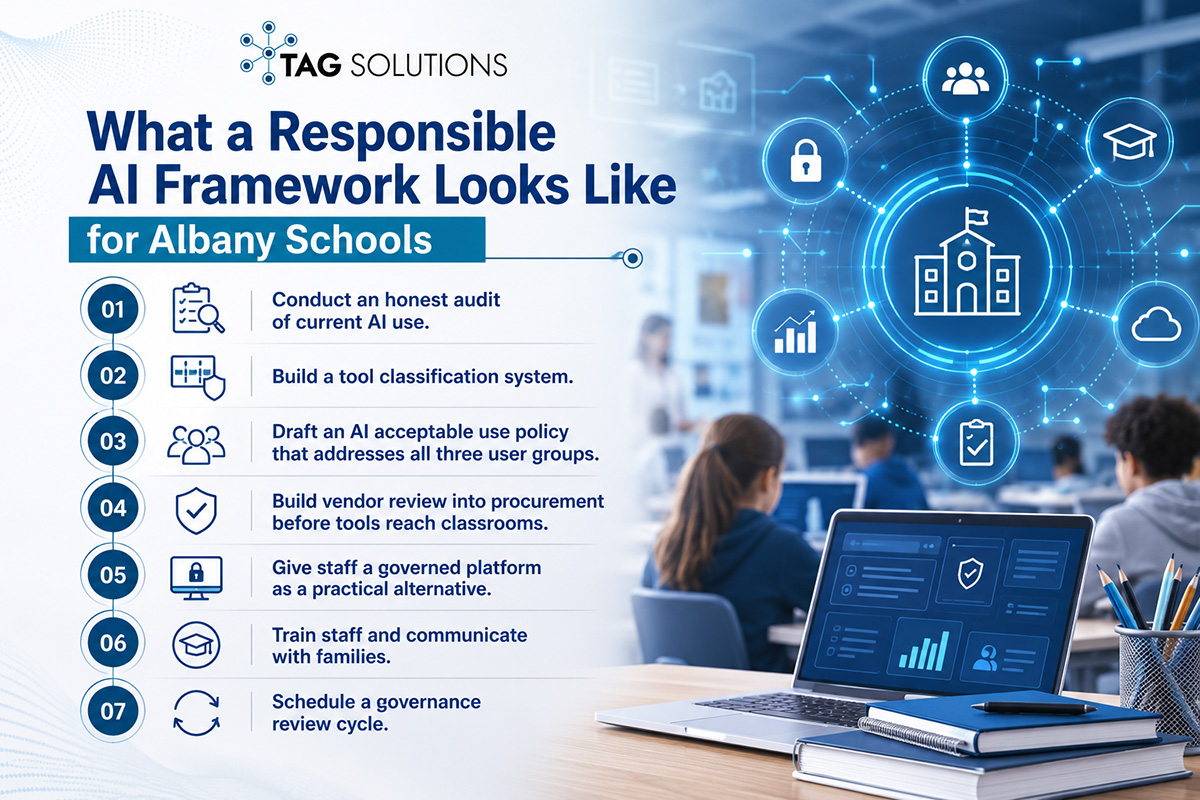
Building AI governance for a school district does not require rebuilding the entire technology governance structure. It requires deliberate additions to what most Albany districts already have. The seven-step framework below is not a checklist. It is a sequence that reflects how these decisions actually need to be made.
Step 1: Conduct an honest audit of current AI use
You cannot govern what you have not mapped. Talk to teachers across grade levels and subject areas. Pull network traffic data. Survey department heads. Ask students, directly or through classroom teachers, which tools they are using for schoolwork. The results of this audit are almost always more extensive than district leadership expects, and that is useful information. It is the baseline everything else depends on. Skipping this step and moving directly to policy writing produces a framework that addresses the wrong risks.
Step 2: Build a tool classification system
A tool that generates generic content without a student login carries a different risk profile than one that requires school-issued credentials, stores conversation history, and processes student-submitted work. A three-tier classification, approved, conditionally approved pending DPA review, and not approved, gives teachers a workable framework. It replaces judgment calls made in isolation with a consistent standard. It also makes the district's procurement decisions more defensible when questions arise.
Step 3: Draft an AI acceptable use policy that addresses all three user groups
The policy does not need to be long. It does need to answer specific questions clearly and separately for students, teachers, and administrative staff. Which tools are approved for each group? What categories of data, student records, health information, financial data, cannot be entered into any AI system, approved or not? What does appropriate use look like in a classroom context versus an administrative workflow? Having those answers in a single accessible document gives the district documented governance intent and gives staff a reference point that is actually usable.
Step 4: Build vendor review into procurement before tools reach classrooms
Any AI tool that will interact with student data needs a vendor review that produces three concrete outcomes: a signed Data Privacy Agreement under Education Law 2-d, a documented assessment of the vendor's data handling and security practices, and a determination of whether the tool can qualify as a school official under FERPA. That review process needs to be embedded in the software approval workflow before deployment, not after. The alternative is discovering compliance gaps in tools that have been in active classroom use for six months.
Step 5: Give staff a governed platform as a practical alternative
Policy without a usable alternative generates workarounds, not compliance. One of the most operationally effective investments an Albany district IT department can make is providing staff with access to a governed AI environment that brings leading models together under district-controlled conditions, with usage logging, data protections, and a compliant vendor agreement in place. Staff get the AI productivity they are already seeking. The district gets audit capability and data governance. And the shadow AI problem, people using unapproved tools because no approved option exists, largely resolves on its own.
Step 6: Train staff and communicate with families
Rollouts that skip the communication step consistently generate resistance. Staff compliance improves when people understand why the policy exists, not just what it requires. Connecting the compliance framework to concrete examples of what data exposure looks like for a district and what the consequences are for families makes the reasoning legible to a non-technical audience. Families deserve transparency about how AI is being used in their child's education. Building that communication into the rollout is not an optional step. It is what makes the framework durable.
Step 7: Schedule a governance review cycle
AI capabilities are not a stable target. A tool that is fully compliant under your current framework may introduce new data practices in a product update six months from now. A governance framework written in early 2026 will need meaningful updates before the school year ends. Building a formal review, quarterly for rapidly evolving tool categories, semi-annually for the broader framework, into the IT governance calendar is what keeps the policy from becoming gradually irrelevant as the landscape shifts.
The Case for IT Leadership to Own This Conversation
Districts that handle AI governance well tend to share one common characteristic. The IT director brought a framework to administration before an incident made it urgent.
That positioning matters more than it might appear. When AI governance enters the conversation reactively, after a data exposure event or an NYSED inquiry or a parent escalation, IT is explaining what went wrong. When IT leadership raises the issue proactively and arrives with a framework in hand, the conversation becomes strategic. The district gains control over how AI adoption unfolds rather than responding to how it already has.
The resource constraint is real and worth naming. Most Albany school district IT departments are managing a complex, multi-site environment with teams that were staffed for a different era of IT. Adding a responsible AI framework to an already full operational calendar is not a trivial ask. A strategic IT partner who understands both the technical environment and New York's specific education compliance requirements can help IT directors build the policy architecture, evaluate vendors, and support implementation in ways that do not require building an entirely new internal capability from scratch.
A vCIO relationship is particularly valuable here because the work sits at the intersection of technology, policy, and organizational communication. The IT director who can translate AI governance requirements into language that resonates with a superintendent and a board of education is going to move faster and with more organizational support than the one who cannot. That is not a soft observation. It is a practical reality in districts where technology decisions require non-technical approval.
How TAG Solutions Supports Albany School Districts
TAG Solutions has worked with educational organizations across the Capital Region for more than 30 years. That history means we understand the specific environment Albany districts operate in, including FERPA, Education Law 2-d, NYSED data privacy guidance, and the operational reality of district IT teams managing hundreds of devices, dozens of applications, and thousands of users with limited staff and constrained budgets.
Every TAG client is assigned a vCIO who functions as a strategic partner rather than a support contact. For school districts, that translates to having someone who can help design the AI governance framework your district needs, review tools and vendors against your specific compliance requirements, support policy development in language that works for both IT and administration, and make sure technology decisions are aligned with your obligations to students and families.
TAG backs its services with guarantees. That is uncommon among IT providers in this market and it reflects a commitment to execution quality that we think every organization, including public school districts, should expect from the partners they trust with their infrastructure.
________________________________________________________________________
If your district is navigating AI adoption without a clear governance framework, the exposure is already accumulating. Building the framework before an incident creates the urgency is considerably easier than building it after.
A conversation with a TAG vCIO is the right starting point. We work with Albany school IT leaders to assess current AI use, identify compliance gaps, and build the governance architecture that makes responsible adoption possible.

________________________________________________________________________
Quick Q&A: AI Governance for Albany Schools
Do FERPA and Education Law 2-d apply to AI tools students use on their own devices?
In many cases, yes. If a student is using a personal device to complete schoolwork, access a school-issued account, or use a tool a teacher has referenced in an assignment, the district may have compliance obligations depending on what data is being processed. A written policy that defines approved tools and prohibited data categories is the clearest way to document the district's governance position and limit exposure.
Can we just add language about AI to our existing acceptable use policy?
You can reference AI within an existing AUP, but the vendor agreement requirements, data classification considerations, and differentiated use cases across students and staff are specific enough that most districts benefit from a dedicated AI policy or a substantive addendum. The goal is clarity and specificity. Staff and students need to know what is approved, what is not, and what the reasoning is.
What is the practical difference between blocking ChatGPT and giving staff a governed platform?
Blocking removes access without addressing the underlying need. Staff who were using ChatGPT to reduce workload will find another tool, often one you know less about. A governed platform provides access to leading AI models under district-controlled conditions, with data protections, usage logging, and a compliant vendor agreement. It resolves the same productivity need without creating a new compliance gap.
How do we handle teachers who are already using unapproved tools?
Start with education rather than enforcement. Most teachers using unapproved AI tools were not aware of the compliance implications and are trying to do their jobs more effectively. A clear policy, a list of approved alternatives, and a plain-language explanation of the compliance reasoning will produce more durable behavior change than a prohibition without a substitute. Teachers respond to understanding the why.
Where should a district IT director start if this conversation has not happened yet?
An audit of current use is the right first step. Conversations with teachers across departments, a review of network traffic data, and informal feedback from students will give you a working picture of the scope. From there, a strategic IT partner who understands New York education compliance can help you build the framework your district needs without placing an unrealistic additional workload on an already stretched internal team.